Tennessee Valley Tactical participates in the Amazon Services LLC Associates Program. We earn commissions on qualifying purchases at no additional cost to you. Specifications drawn from manufacturer and retailer listings and were accurate at the time of writing.
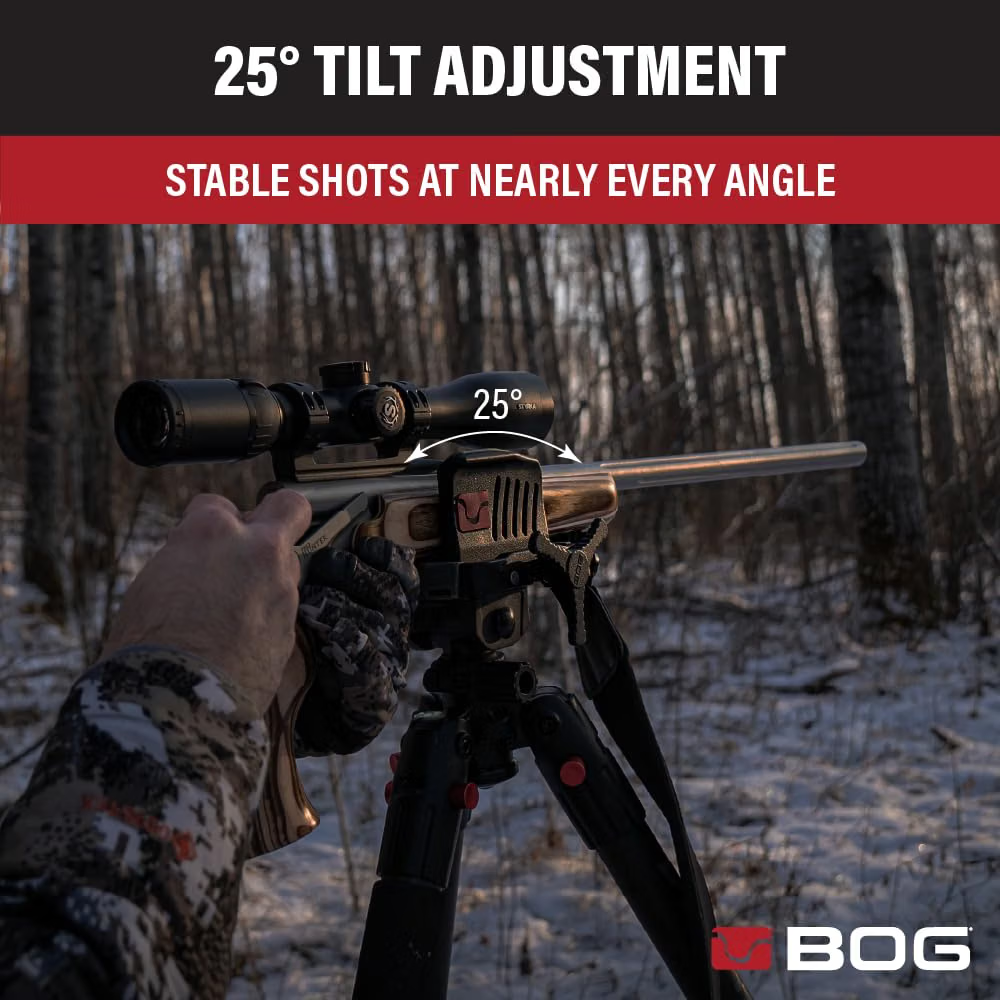
The BOG DeathGrip does something most shooting rests don't: its patented head clamps the rifle and holds it, so your hands come off the gun entirely. You can glass, work a call, adjust position, and come back to a rifle still pointed at where you left it. That's the feature, and it's a legitimately good piece of engineering.
At 8.5 pounds for the aluminum version, it is also heavier than a set of shooting sticks or a bipod. BOG built this for open-country Western hunting — long glassing sessions, unknown ranges, shots taken standing off a truck-accessible field edge. The question for a North Alabama hunter is whether the way you hunt here gives it anything to do.
Where the DeathGrip earns its weight in the Tennessee Valley
1. Coyote calling — this is the best case, and it isn't close
Alabama coyotes are open season year-round with no bag limit on private land, and a called setup is exactly the scenario a clamping tripod was designed for. You're sitting on a field edge for a thirty-minute stand, rifle ready at the likely approach, hands free to work an e-caller or a mouth call, binoculars up to spot a dog working the tree line.
The clamping head holds zero on that tree line while your hands are everywhere else. Compare that to shooting sticks, where you're supporting the rifle the whole time and any hand movement costs you your ready position. For a standing coyote at 150 yards working toward a call, hands-free hold when the animal commits is the difference between a settled shot and a scramble.
2. Hogs at night
Feral hogs in Alabama have no closed season, no bag limit, and no license requirement on private land. A lot of Tennessee Valley hog hunting happens after dark over a field or feeder — thermal or night vision with a light source — from a ground position with no structure.
The clamping head holds your rifle pointed at the feeder while your hands are on the thermal monocular. The bubble level matters more here than it does in daylight — canting a rifle in the dark is easy to do and will walk your shots at field distances. A level you can feel with your hand before the shot is a practical tool, not a range accessory.
3. Field edges and river bottoms without a structure
Not every good spot has a shooting house. If you're sitting a fencerow on a Limestone County bean field, a cut cornfield along the Tennessee River, or a power line right-of-way, you're shooting from a ground position at distances that reward a stable rest. A tripod is a meaningful upgrade over cross-sticks or a seated offhand shot at 200 yards of open ag ground.
Pair it with angle-compensating glass and you've solved the two problems of a bluff-edge setup at once — range-compensated hold and a stable rest for a shot that matters.
Where it doesn't fit North Alabama
Shooting houses over green fields. If you're hunting from a structure with a window rail and a bag, you already have a more stable rest than a tripod. This is a solution to a problem you don't have in that setup.
Public land walk-ins. Skyline, Bankhead, Freedom Hills, and the Jackson County units are steep, and the productive ground is generally not the ground near the parking area. Eight and a half pounds is a significant addition to a pack for terrain that produces close shots from whatever position you can get into quickly.
Timber ridge hunting. When a buck steps out at forty yards in the hardwoods during the October rut, you don't have time to clamp a rifle into a head. Offhand or a quick lean into a tree is what works in that situation. This tripod is for the setup where you know the distance and have time to be deliberate.
Inside a ground blind. Mind the footprint. A typical 58" × 58" hub blind gives you about twenty-three square feet of floor, and a tripod with legs spread at seated height eats most of it. Works in a larger blind; gets crowded fast in a standard pop-up.
Specs
| Spec | Aluminum | Carbon Fiber |
|---|---|---|
| Weight | ~8.5 lbs | ~7.5 lbs |
| Head | Patented clamping — holds rifle hands-free | |
| Feet | Retractable steel spikes | |
| Level | Bubble level | |
| Price delta | Base | Meaningfully higher |
| Best for | Truck-accessible setups, field edges, feeders | Weight-limited pack-in trips |
Aluminum or carbon for Tennessee Valley hunting?
Carbon fiber saves about one pound at a noticeably higher price. In Western hunting where you cover miles of country on foot every day, that's an easy call. Here it usually isn't.
If the tripod rides in the truck to a field edge or a feeder, buy aluminum. It's going to get set down in mud, leaned against a truck bed, and treated the way truck gear gets treated. Aluminum handles that without worry. Save the carbon fiber premium for the weight-limited trips you're actually taking — and for most Tennessee Valley hunting, you're not carrying this tripod up a ridge.
Practical notes
- Set the pan tension before you hunt, not during. Too loose and the rifle drifts when you let go; too tight and you can't track a moving animal. Find the right setting at home and mark it.
- Retract the spikes on hard surfaces. Steel feet on a wooden shooting house floor or a concrete pad will skate and tip. The spikes are for soft ground — pack in dirt, field edges, gravel. On hard surfaces, retract them.
- Verify zero after clamping. Clamping pressure on a forend can shift point of impact on some rifles, particularly sporter-contour stocks with thin forends. Confirm your zero with the rifle clamped in the head before the season.
- Practice the mount cold. Getting a rifle into the clamp quietly and quickly is a learned motion. Do it enough times in the backyard that it becomes automatic. A coyote at the tree line doesn't wait for you to figure out the clamp.
- It is not a spotting scope tripod. The clamping head is built for a firearm and swapping to a ball head for optics is not a convenient field modification. If you want a glass tripod, buy one purpose-built for it.
The verdict for North Alabama
| Situation | Verdict |
|---|---|
| Coyote calling, private land | Buy it. Best North Alabama use case by a significant margin. |
| Hog hunting at night with license | Buy it. Hands-free hold plus bubble level in the dark is a meaningful setup. |
| Open ag ground without a structure | Buy it. Fencerows, river-bottom fields, power line cuts — anywhere the distance is real and the setup is deliberate. |
| Shooting house over a green field | Skip it. You already have a better rest. This solves a problem you don't have. |
| Walk-in public land hunting | Skip it. 8.5 lbs on Skyline or Bankhead is hard to justify for the shots that terrain produces. |
| Timber ridge deer hunting | Skip it. Close, fast shots don't give you time to use the clamp. |
The DeathGrip is not overhyped — it does exactly what BOG says it does, and the clamping head is a legitimately good piece of engineering. It's a tool built for a kind of hunting that a significant portion of North Alabama hunters don't do — and a tool that is exactly right for the ones who do.